

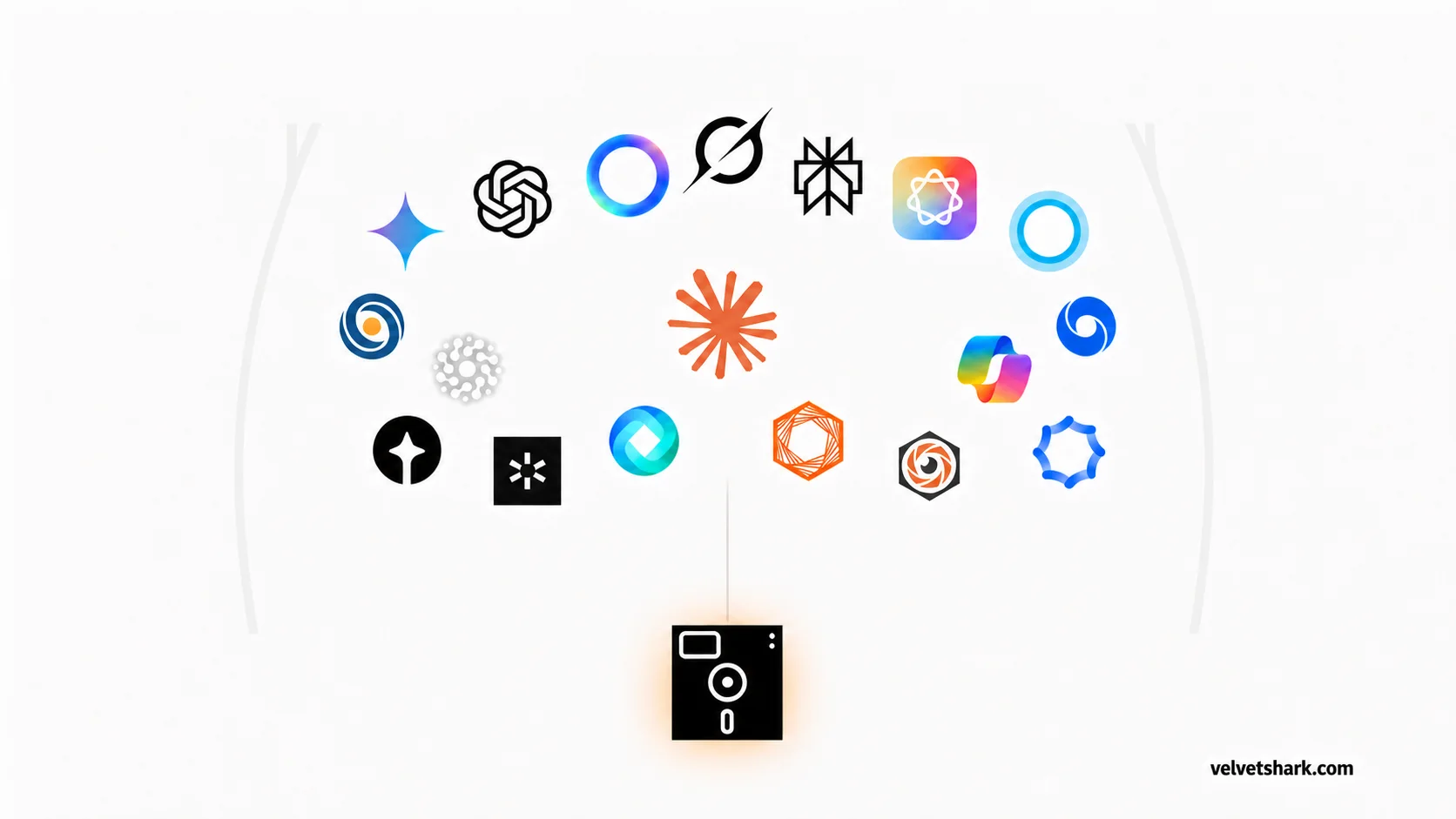
Lately, I keep thinking back on a VelvetShark piece that made the rounds last year. One with a title that says it all: "Why do AI logos look like buttholes?"
The surface argument is the joke, but there's more to it. But to linger on the rim of the real argument for a moment, AI logos are always a circle, a soft gradient, an opening in the middle, maybe something radiating out from the center. Radek Sienkiewicz (aka VelvetShark) singles out Claude as the clearest offender, with a side-by-side comparison of the Anthropic logo and Kurt Vonnegut's illustration of an asshole from the novel Breakfast of Champions. They're pretty much identical. So it goes. (IYKYK.)
But the resemblance isn't the interesting part. The interesting part is why it keeps happening. His real point, past all the jokes, is about sameness: these logos converge because the thinking behind them converges. Design by committee. Play it safe. Make it feel "advanced but approachable." Nobody in the room wants to be the one weird logo, so everyone ends up as the same reassuring gradient blob. Then the industry decides that blob is what serious AI is supposed to look like.
At Basic Memory, we have opinions about this, partly because we're the company everyone calls "BM."
But our vintage disk logo didn't come from a committee meeting, and our name didn't emerge from a branding exercise. It came out of a Turing machine.
Where the name actually comes from
Our parent company is Basic Machines, and the name is lifted straight out of an old college textbook of Paul's: Lewis and Papadimitriou's Elements of the Theory of Computation, from the chapter on Turing machines. There's a section in there called "The Basic Machines." It introduces the two most trivial devices you can imagine: one that writes a single symbol, and one that moves the tape head one square. That is the entire toolkit. The rest of the chapter shows you how to wire those two basic machines together into something that can actually do something, like multiplying two numbers.
Basic parts, combined, make complex things. That's the whole idea.
The sameness isn't skin-deep
The sameness VelvetShark is mocking on the outside is the same sameness happening on the inside. Nearly every AI company is building the same kind of memory: a proprietary, opaque store you can't open, can't read, can't edit, and definitely can't take with you when you leave. The logos converged because the architecture converged. Look like a platform. Build the monolith. Keep the user's knowledge somewhere the user can't quite reach so they couldn't leave you even if they tried.
We went the other way, deliberately, at every layer. Our logo is a floppy disk. Square, hard-edged. (Worth noting that VelvetShark's own advice for escaping the blob is to "embrace sharp angles.") And our memory is just Markdown files. Plain text. Yours. You can read every word your AI wrote, edit it however you like from anywhere you want, and walk out with all of it whenever you feel like it. There is no blob.
And it still does the same job as the monoliths, but it does it better. When your AI needs something, Basic Memory finds it. Semantic search across your notes, plus the links between them that turn a pile of files into a graph. You just also happen to be able to open, read, and edit every one of those files yourself. It's as transparent as possible.
The building blocks are simple by design
A few pages after "The Basic Machines," the authors ask the obvious question: what if you gave the machine more? More tapes, more heads, a big two-dimensional surface to work on. Surely a fancier machine can do more than a basic one.
The surprising answer is no. Every one of those souped-up machines can be perfectly simulated by the plain, basic one. The extra machinery buys you nothing.
That's the whole philosophy. You don't need elaborate, proprietary memory systems to give an AI a good memory. The simple, boring version made of files you own already does everything the complicated version does. Because Basic Memory at scale is complex memory without the bullshit.
Every AI company's memory looks the same because it's built the same way. Ours doesn't, because it isn't. If you want a memory for your AI that's actually yours — readable, editable, portable, plain — that's the entire idea, and you can read more about why we built it this way or just try it.
Your knowledge should be yours. Even the logo agrees.