

This is the second issue of Context Clues, the Basic Memory newsletter. Subscribe here.
Hey there,
We have so many announcements this month that I'm going to offer the TL;DR up front.
- Basic Memory Cloud is 1 year old. (Holy smokes!)
- BM is leaving beta. (1.0 baby!!)
- We're introducing usage-based pricing. (No change for most of you, and a real path for heavy users.)
- We're introducing Memory Agents. (Knowledge base management made easy!)
- Paul is finally full-time at Basic Memory. (Somehow he is even busier.)
Watch the 1.0 film on YouTube (one minute).
One Year Anniversary
So, yeah, it's the one-year anniversary of Basic Memory Cloud. I know people usually say "it feels like only yesterday," but it actually seems like ages since we invited our earliest users to make the leap from the open-source project. Internally, we called them The Beloved 25. (You know who you are.)
Wildly enough, most of them are still with us. Thanks, guys, for sticking around. Much love!
Bye Bye, Beta
I realize leaving beta is kind of an arbitrary distinction. It boils down to just believing the core features are essentially locked and that the system is stable enough to meet whatever demands the users might present. We've gone back and forth about when to leave beta. (How many times was I reminded that Gmail was in beta for over 5 years?) But really there were just a few things we wanted to get dialed in before we finally made the leap.
We've been talking it over, and finally just sort of agreed, "Hey, we're there."
So, welcome to Basic Memory 1.0. It comes after more than 90 releases, over 1000 pull requests, and over 50 contributors. Huge thanks to everyone who has contributed to and worked on Basic Memory.
Usage-Based Pricing
This one requires a little backstory (a.k.a. backpedaling).
When we launched Basic Memory Cloud, we were very much into the idea of flat pricing. Sure, the tech world had moved on to usage-based billing, but we were going to be different.
Even a year ago, we were already burnt out by rate limit resets and weird pricing charts where you get assigned an arbitrary number of an arbitrary thing: credits, memories, tokens, requests. It all just seemed like a lame way for companies to deliberately obscure what consumers were really getting. The rules were always changing, and the consumer was in the dark about how much work they could do with the tools they relied on.
I tried some AI image creation thing at one point to make thumbnails for YouTube videos and discovered after making three images that if I wanted to keep going I'd need to buy more credits. Were my requests too complex? Had I edited them too many times? No idea. It was all just another crappy black box, and we weren't interested in joining the fray.
Flat pricing was great on our end, too. It meant that we didn't have to think much about billing. Nothing is more plug-and-play than everyone getting the same thing for the same price.
But a year has shown us that our quest for punk rock tech egalitarianism wasn't quite the utopia we imagined. And, worst of all, the problems were mostly for our users.
The issue that increasingly presented itself was that of users who wanted to use a lot more of Basic Memory than our (truly very generous) allocations allowed. They were making so many requests we couldn't service them and still keep our heads and margins above water.
For 90% of our users, there were no issues. They could use Basic Memory A LOT without ever butting their heads against our ceiling.
But you know how it is with AI. Once you have fifteen scheduled processes running daily (or, in the case of some of our users, hourly), things begin to spin a bit out of control. They didn't just need tons of usage, they also wanted to do more with the project in general. Basic Memory had become a cornerstone of their daily workflow, and they wanted more than just more usage. They wanted to work with API keys and discrete, identifiable agents that could write to their knowledge base pretty much continuously.
The compute wasn't the issue. You can always get more of that. We were just going into the red essentially running a charity for a tiny portion of our user base. Some contacted us to say that they didn't feel great about the arrangement either. They guessed (correctly) that what they were paying couldn't possibly cover what we were spending on our end to keep them afloat. So we ended up improvising unique solutions for individuals and companies who needed more.
Then there was the question of how we were handling Basic Memory "seats." We had originally undertaken the teams project intending for it to be its own product at an increased pricing tier, and at the last minute said, "You know what would be cool? What if every Basic Memory user had access to BM Teams? We don't need to charge them more. Give it to everyone!"
Talk about utopian! Talk about heroic!
And it worked…for, again, 90% of our users. People immediately understood the value of Basic Memory Teams and started using it with multiple coworkers, colleagues, and collaborators. But for that remaining 10%, our stab at generosity created some funky, oddball edge cases where people were kind of forced into buying multiple seats to access different team knowledge bases. If you were sharing work with both Company A and Company B, you somehow ended up paying for two seats. Which was, you know, cool for us, but not so great for them.
So the people who were using BM the most were, once again, the ones who got dinged by our attempts at an all-purpose solution.
It hasn't sat right with us, and for the past few months, we've been rethinking our approach.
The more we talked about it, the more we realized that the thing we hated about usage-based pricing was the lack of transparency, the bullshit unknowability about what our own usage even looked like. What's more, the lowest rung of most usage-based plans is just high enough to get you hooked while still being too low to get real work done.
What if the answer was the one we'd been avoiding all along? Usage-based pricing, BUT with our idealism intact?
Actual, transparent dashboards that show exactly how much you, your teammates, and your agents are using at any given moment. So, yes, we're moving to the dreaded "credits" style system, but one that shows you what a "credit" is right up front. It'll be straightforward and streamlined.
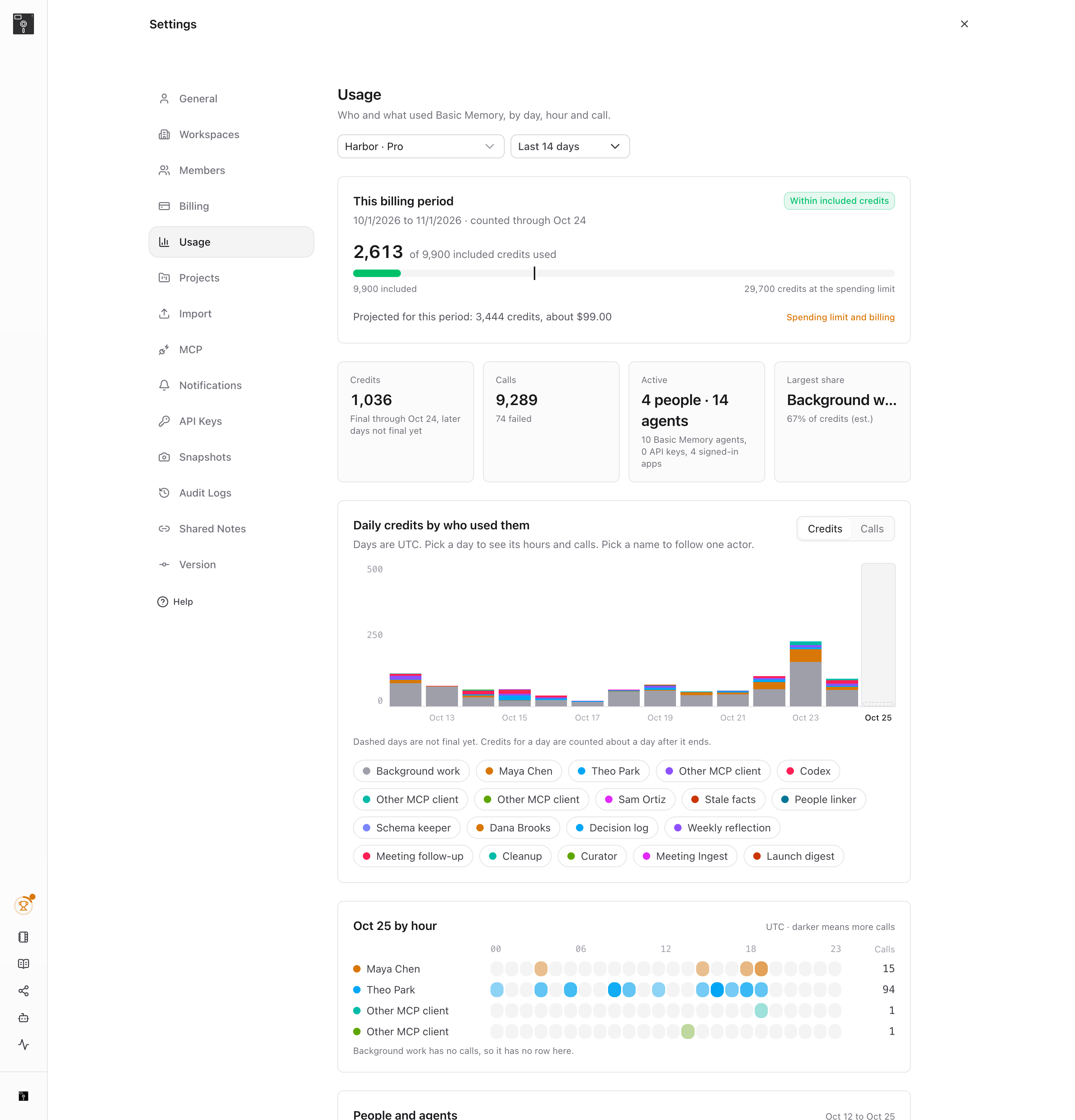
And if you're already using Basic Memory, there's no pressure to switch. If you're in the 90% of our users who are well within the bounds of our current limits and are happy, feel free to stay right where you are. We'll keep on supporting your work.
We can run a business without being assholes. We really can!
So in a nutshell: we'll still have a low-price tier that will be more than adequate for most consumer-level users. They'll get lots of BM miles (there's a "token" analog no one's used yet), and they'll be able to use Basic Memory Cloud features with a partner.
Then we'll have Pro and Business tiers. You can see the details here. If you're using agents, especially, you're going to like what you see.
Memory Agents
This is one of the things we've been building towards for ages. Picture a little broom sweeping up your notes that makes sure everything is where it belongs, in your preferred format (or schema), and free of repetition. Picture agents that can do anything you can think to do with your notes. This is what Anthropic calls "dreaming". We prefer to avoid that kind of pseudo-anthropomorphizing terminology. It's really just another agent working for you in your notes.
An example of an issue that popped up more than once for me: I'd tell my AI to make a folder or note for something, forgetting that I'd already had it make exactly that folder or note.
I'd say, "Hey, put this all in a folder called Newsletter/Blog."
Claude wouldn't say, "Oh, hey, this already exists, I'll just add it there." Instead, it would create a duplicate. Later, I'd look and find two Blog folders: the one I'd made weeks earlier and a new one inside Newsletter. Then I'd spin my wheels telling Claude or ChatGPT to fix it and waste tokens having them do a kind of cleanup I didn't want to. Now this can just happen...automatically.
For most users, Basic Memory quickly becomes integrated into their daily workflows. We've heard time and again that they wanted to do more than just tidy up notes. They wanted watcher agents that pay attention to certain folders and process them in particular ways.
Put all your meeting transcripts in one place? Create an agent that watches that folder and processes the notes however you like.
Want stuff to happen on a schedule? Feel free. It can work while you sleep.
You're only limited by your imagination and the data you save in Basic Memory.
(That's two corny-but-true lines in a row. Sorry.)
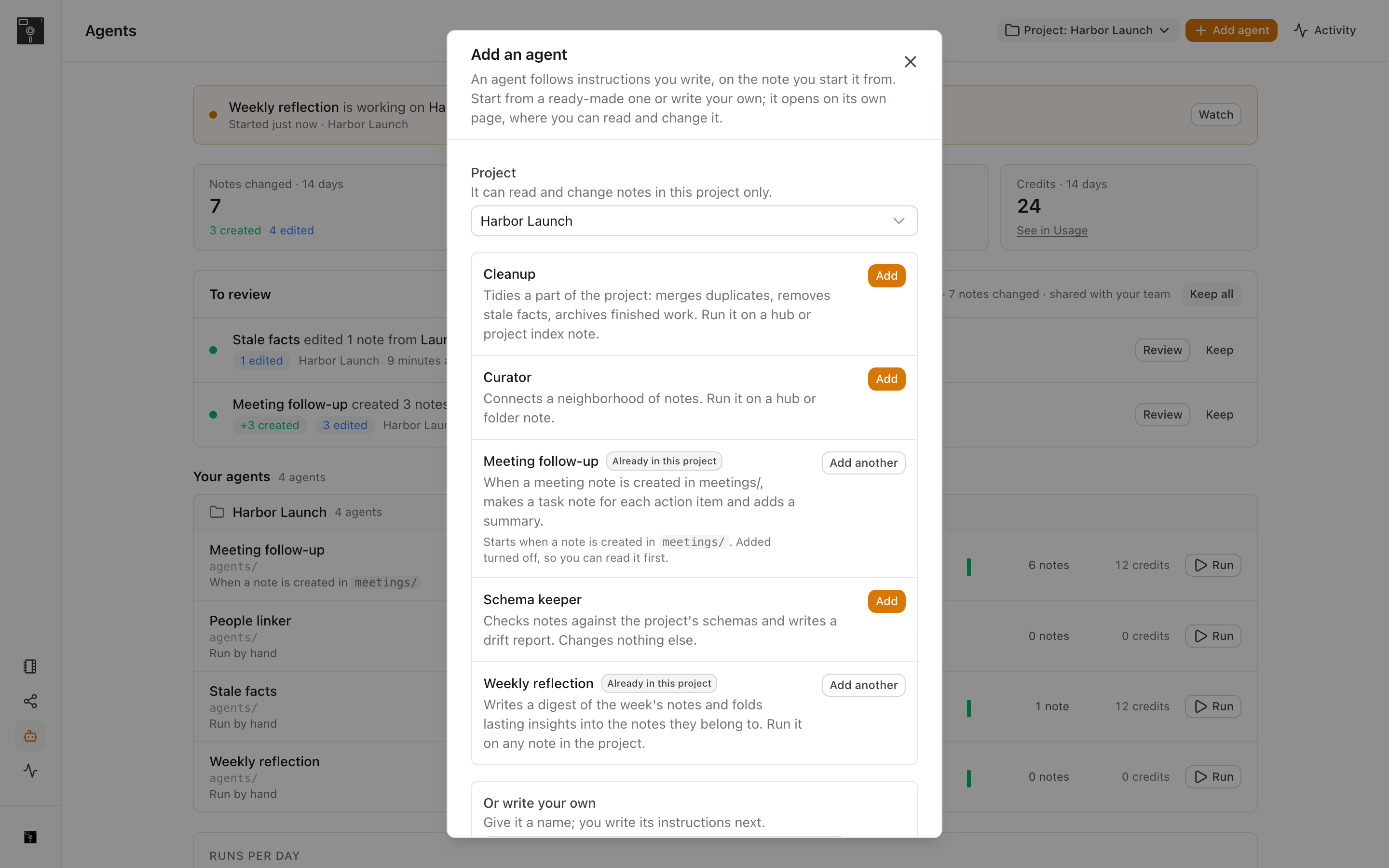
If you don't feel like doing it yourself, your AI assistant can help you by creating whatever Memory Agents would serve you best. Agents are just notes. Claude or ChatGPT can create them and manage when they run. When they see the framework, they catch on fast.
Oh, and we're powering Memory Agents internally with DeepSeek v4.1, which is fast, cheap, and smart as hell. More on open weight models soon...
Paul Is a Full-Time Founder
Paul is now working full-time on Basic Memory. As you may know, we have always been a small, bootstrapped company. That's important to us, so we can focus on building our own vision of AI-enabled memory and focus on our customers without outside influence from people writing us the big checks. Up until now, we have all had to take on outside work, but Paul is finally able to devote his full energy to Basic Memory. We are not short on ideas, so expect a lot more to come!
Along with this, we have more capacity to take on enabling organizations to create and deploy their AI strategy (of course we suggest using Basic Memory). If you know anyone that is stuck in analysis paralysis with the plethora of choices in rolling out AI in their organization, give us a call. We'd love to help.
You can book some time for a no-hassle chat here.
Here's the rest of what's in 1.0, in one place
- Memory Agents. Write the upkeep down once, as a note. Agents file, link, summarize, and check your knowledge on schedule, and every change can be kept or undone.
- Wiki Mode. Point it at a folder and Basic Memory connects the notes for you. It keeps an
index.mdthat links everything, and updates it as your notes change. - Interactive notes (Comark components). Notes can hold live pieces: boards, KPI cards, and queries that update themselves. A launch dashboard can be a note, not a separate app.
- Document ingest and extraction. Drop in a PDF, DOCX, PPT, or CSV and you get a sidecar note with the extracted text and structure. Your AI can read and search it like any other note.
- Agent keys with identity and permissions. Every agent gets its own key, its own name, and only the access you give it. Every edit is credited, so you always know who (or what) changed a note.
- Change review. When an agent edits your notes, you see the diff and keep it or toss it.
- Twelve new tools. The
bm_*tools give your AI one clean way to read, write, edit, search, and review your notes. - Dated facts. Notes can say when something was true, and search can ask "what did we know as of July 1st?"
- Safe writes. If your AI tries to edit a note that changed since it last read it, the edit is refused instead of overwriting someone's work.
We've released so much lately. Check out our release notes in this shared Basic Memory note. (Pretty cool, huh?) They're also here on the blog.
Thanks for reading all this. We look forward to making many more memories with you.
Sincerely,
Drew Smith
Basic Memory
This was the second issue of Context Clues, the Basic Memory newsletter. Forward it to the friend who keeps losing work between AI conversations. If you're not subscribed, you should be.